
Since being established on July 1, 2011 through bipartisan legislation, the Connecticut Green Bank has grown from a new idea into the nation’s model green bank. Here’s a look back at key milestones in our history, the people who helped shape it, and the individuals we honor in our Hartford headquarters.
Milestones since 2011

The Green Bank is established with bipartisan leadership from Governor Malloy and Connecticut’s General Assembly on July 1, 2011, through Public Act 11-80, as a quasi-public agency that superseded the former Connecticut Clean Energy Fund.

The Residential Solar Investment Program (RSIP) launches.

The first Solarize campaign launches, using a community-based approach to reduce costs and accelerate adoption of solar. C-PACE, Smart-E Loan, CT Solar Loan, and residential Solar Lease all launch, with $100M in private investment funding over 1,000 projects.

The first Multifamily Loan project closes. President Barack Obama acknowledges the Green Bank’s leadership in a speech on American energy given on May 9, 2014.

$1 billion in private investment has now funded over 10,000 projects. The 100th C-PACE project closes, and public health savings to the Connecticut economy surpass $100 million.

Over $30 million in tax revenue is generated for the state.

C-PACE surpasses $100 million in total capital deployed. The Ash Center for Democratic Governance and Innovation at Harvard Kennedy School names the Green Bank winner of the 2017 Innovations in American Government Award. Over 20,000 projects have now closed, attracting over $1 billion in private investment.

Over $60 million in tax revenue has now been generated for the state. The Green Bank receives the 2018 CESA SLICE award for its PosiGen partnership on Solar for All.

RSIP proves successful at increasing solar deployment in communities of color and low-to-moderate income households, establishing Connecticut as a “solar with justice” state. The 100th C-PACE project closes.

The first Green Liberty Bond launches in honor of the 50th Earth Day, selling $17 million in bonds. The Green Bank receives Environmental Finance’s 2020 Bond Awards for Innovation in Green Bond Structure and Asset-Backed Bond.

The Green Bank model is expanded through bipartisan legislation to include environmental infrastructure. RSIP hits its 350 MW target ahead of schedule, with more than 43,000 homes having adopted solar.

Energy Storage Solutions launches in partnership with Eversource and United Illuminating. The 6,000th Smart-E Loan closes.
Green Bank Heroes
In the summer of 2021, the Green Bank moved into its Hartford headquarters in the Non-Profit Center at 75 Charter Oak Avenue, out of a desire to be closer to the community we serve. The building itself is a former brownfield that once held the Atlantic Screw Works, where screw-making machines were built in the late 1800s. As we branded the space to match our story, we honored Connecticut’s rich history of innovation and climate activism through our meeting spaces, each named for a hero.
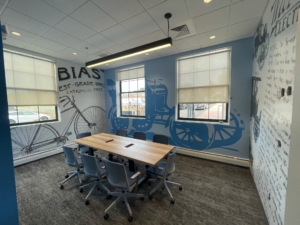
Albert Pope
One meeting room is named after Albert Pope, a Civil War veteran, manufacturer, distributor, and entrepreneur who lived in Hartford (1843-1909). Pope initially focused on making America's first bicycles through the Columbia Bicycle Company, then turned his attention to the first electric vehicles, employing thousands of people in what was the center of the automobile industry in the late 1800s. In 1902, President Theodore Roosevelt rode in a Columbia Electric Victoria Phaeton, made by Pope, in the first Presidential motorcade in an electric vehicle.
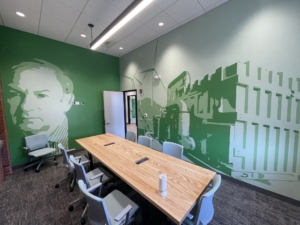
Dr. Bernard S. Baker
This room, our green hydrogen room, is named after Dr. Bernard S. Baker, a Connecticut resident and pioneer in the fuel cell industry. He was a founder and served as president, CEO, and chairman of Energy Research Corporation (now FuelCell Energy, Inc.) in Danbury, a developer and manufacturer of direct fuel cells used to generate electric power. Connecticut continues to be a leader in fuel cells, thanks in part to Baker's work.
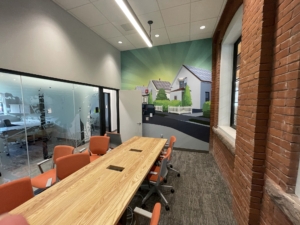
The Freeman Sisters
This room is named after Mary & Eliza Freeman, whose historic Bridgeport homes are the last surviving from the "Little Liberia" settlement of free African Americans, started in 1831. Now part of the Freeman Center, the preserved homes sit in the shadow of a coal-fired power plant, serving as a reminder of the need for environmental justice. The room has two striking walls: one features Maya Angelou's poem "On the Pulse of Morning," and the other has an image of solar homes based on Prince Street in Bridgeport, where Melvin, who went solar in 2015, convinced three neighbors to follow suit after seeing his savings. There is also a glass mural commissioned by Aisha Alford of Bridgeport.
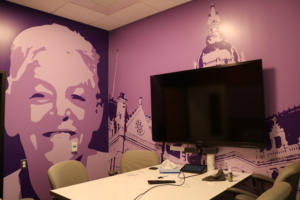
Gina McCarthy
This meeting space is named for Gina McCarthy, a former Green Bank Board member who went on to serve as Administrator of the U.S. Environmental Protection Agency and as the first White House National Climate Advisor.
Former Green Bank Stars
When talented staff members and Board members leave the Green Bank, we’re often excited to see them take their interest, knowledge, and skills to other organizations that continue to serve the green economy. We have the privilege of maintaining positive, collaborative relationships with these leaders as they make an impact in their current and new roles. Click on a name to visit their LinkedIn profile.